Appendix I:

OSU Joint Information Centers (JIC)

Purpose of a Joint Information Center (JIC)

To ensure coordination of public information during incidents that involve multiple agencies and/or jurisdictions; a JIC supports the gathering, verification, coordination, and dissemination of accurate, accessible and timely information.

The JIC is a central location that facilitates operation of the Joint Information System (JIS). The JIC enhances information coordination, reduces misinformation and maximizes resources by co-locating PIOs as much as possible.

JICs can be organized in many ways, depending upon the nature of the incident:

Incident JIC
  • Optimal physical location for assigned PIOs to co-locate.
  • Media access is primary consideration.
Virtual JIC
  • Established when a physical co-location is not feasible.
  • Connects PIOs via email, cell/landline phones, faxes, video conferencing, etc.
  • Incorporates technology and communication protocols.
Satellite JIC
  • Smaller spaces than other JICs.
  • Established to support the incident JIC and to operate under its direction.
  • Typically located closer to the scene.
  • Is not independent of the incident JIC.


Potential JIC locations at OSU

  • LaSells Stewart Center.
  • CH2M Hill Alumni Center.
  • Adams Hall (has building backup power)

Potential satellite truck locations at OSU

  • Intermural Lane.
  • SE Corner Reser parking lot (26th and Western).

Potential media briefing location at OSU

  • Valley Football Center.
  • LaSells Stewart Center.
  • CH2MHill Alumni Center.
  • Memorial Union Ballroom.

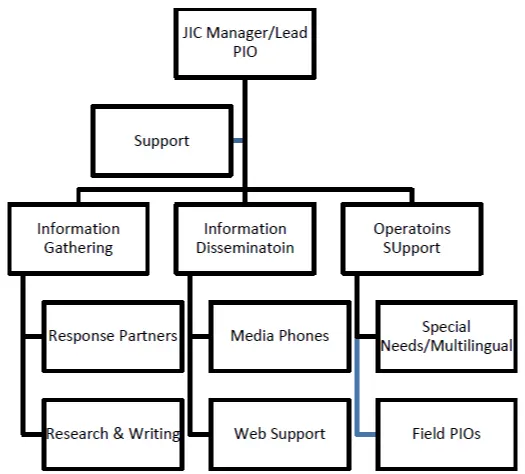
Sample JIC operational structure
Image
Tree of JIC Roles


Image Description: Organizational chart depicting the structure of a Joint Information Center (JIC). The hierarchy flows from top to bottom as follows:

Top level: JIC Manager / Lead PIO

Second level: Support — reports directly to the JIC Manager/Lead PIO

Third level: Three branches report to Support:

  • Information Gathering
  • Information Dissemination
  • Operations Support

Fourth level: Each branch has two units reporting to it:

  • Under Information Gathering: Response Partners, and Research & Writing
  • Under Information Dissemination: Media Phones, and Web Support
  • Under Operations Support: Special Needs/Multilingual, and Field PIOs

JIC Roles

Title Tasks
JIC Manager/ Lead PIO
  • Manages the JIC.
  • Serves as advisor to IC.
  • Provides overall communication policy direction.
  • Recommends and develops strategies for messages, briefings, news releases.
  • Obtains approval for releases.
  • Conducts JIC briefings.
Support
  • Coordinates opening, setup, and closing of JIC.
  • Ensures adequate equipment and supplies.
  • Coordinates JIC security and other services.
  • Manages JIC support services.
Information Gathering
  • Response Partners
    • Coordinates with supporting response agencies and their PIOs at EOCs, incident command posts and other locations to gather information on the incident.
  • Media Monitoring Analysis/Rapid Response
    • Review of media reports for accuracy, content, and possible response.
    • Review social media for accuracy, content, and possible response.
  • Research and Writing:
    • Develops content – Written materials such as news releases, social media messages, fact sheets, flyers, etc…
    • Provides graphics support – Entails designing layouts, developing PowerPoint presentations, and creating graphics for a range of materials (e.g., newsletters, flyers, etc.).
  • Audio-Visual:
    • Broadcast Operations – Entails developing video documentation, special productions, remote live interview feeds and logistical support of public meetings and presentations.
    • Photo Video – Entails providing still photography documentation to support print and online media needs, and video documentation to support broadcast media needs. Also includes collecting materials for agency archives.
Information Distribution
  • Briefing/Special Events:
    • Entails handling events such as news conferences, media briefings, VIP visits, and tours for senior officials of affected areas.
  • Media Relations:
    • Establish a News Desk – Serves as the primary point of contact for the media.
    • Determine a spokesperson – Prepares and conducts regular news briefings.
  • Digital Support – Entails creating and maintaining web pages and social media content with information about the incident for use by the public and the media.
  • Public Inquiries – Entails responding to questions from citizens, making referrals, and developing a log of telephone calls, e-mails, etc., containing names, addresses, the type of calls, and any necessary follow-up actions.
Operations support
  • Special Needs/Multilingual.
    • Entails providing language translation and other services to ensure appropriate and timely information reaches those in the affected areas with special needs.
  • Field PIOs.


JIC location planning considerations

  • Close to the best source of information, without compromising safety or security of personnel or the operations.
  • Sufficient space.
  • Sufficient power, internet connection and communication infrastructure.
  • Sufficient parking.
  • Security.

Activation of JIC

  • In the early stages of response to an incident, the PIO shall consult with the IC/UC regarding the opening of a JIC.
  • The IC/UC shall retain authority to order the opening of a JIC, although the lead PIO may recommend when it is appropriate.

JIC Information Functions

Gather
  • SMEs in the JIC.
  • Field PIOs.
  • Monitoring reports.
  • Other JICs.
Verify/ analyze
  • SMEs in the JIC.
  • Field PIOs.
  • Other JICs.
Update message
  • Who is your audience?
  • What is the objective of the communication?
  • What is the message?
  • Multimedia in message.
    • Photos.
    • Graphics (static/interactive).
    • Video (raw, edited, b-roll, soundbites.
Coordinate, approve
  • How quickly information expires/needs to be updated?
  • Levels of coordination/approval
Dissemination
  • How will you send your message?
    • Website.
    • Social media.
    • Commercial distribution (TV, radio, newspaper).
    • Face-to-face (interview, press conference/briefings).
Document, track
  • Log distribution (date, time, sequence number)
  • Log approval chain
  • Post internally (call center, JIC staff)
Monitor
  • Listen for impact.
  • Local media.
  • Social media.
  • Subject Matter Experts (SMEs).
  • Field PIOs.


Demobilization of JIC

  • When operational activities decline, public information functions transfer back to responsible jurisdictions and agencies.
  • When the Incident Commander makes a decisions to shut down the JIC:
    • Prepare a deactivation media release.
    • Notify community communication managers and local officials.
    • Provide casebook/historical communication to organizations that will assume responsibility for ongoing public information.
    • Complete After-Action Review.
    • Return borrowed equipment and supplies.
    • Inventory equipment supplies, replenish as needed.

Suggested supplies of JIC

  • Hand sanitizer.
  • Kleenex.
  • Paper towels.
  • Cell phone/telephone.
  • Charging cords, plugs.
  • Extension cords.
  • Laptop, speakers.
  • Power strip.
  • Printer.
  • Photo copier.
  • Web camera.
  • Office supplies.
  • USB drives.
  • Digital cameras.
  • Mobile Wi-Fi.
  • Projector.
  • TVs.
  • Tables.
  • Chairs.
  • Lectern.
  • Sound system.
  • Trash cans.
  • Press conference staging area materials.
    • Lectern or table.
    • White board.
    • Microphones.
    • Loudspeaker system.
    • Maps/visual display materials.
  • Contact phone list.
  • Plans.
  • Business cards.