

Appendix J:
Safety Messages
Oregon State University has a responsibility to its community to provide timely communications about safety matters. The following principles and values represent the foundational agreements that underpin this important work.
Safety messages may include Clery Timely Warnings, public safety notices, RAVE notices, news releases, social media communications, website information, and departmental communications and may be distributed to a variety of audiences, including a specific OSU campus community, an audience affected by a safety matter, the overall university community or the general public.
These principles and values empower those responsible for safety communications to make decisions about message content and distribution to contribute to safety and help keep the OSU community informed of important safety matters.
- OSU departmental messages informing the university community about safety matters carry significant weight and represent the university as an institution.
- OSU safety messages are used when university leaders believe a communication is necessary to inform the university community and contribute to community safety.
- When a public safety matter does not meet all criteria required of a Clery Timely Warning, university leaders may still determine a safety message is appropriate.
- Safety messages may best be sent to specific audiences and not to all community members.
- All safety-related messages will contain specific and actionable content. If it is not possible to provide specific and actionable information, university leaders will assess whether a safety message is appropriate.
- All safety messaging decisions will include consideration of additional impacts and unintended consequences on university departments and community members.
- University safety messages should address the current matter and audience impacted.
- Templates with standard messaging are encouraged. However, specific information based on the current matter should be included when using templates.
- The decision-making process for communicating safety matters will respect the multiple roles and professional responsibilities within the university.
The OSU Alert system is the primary distribution mechanism for emergency notifications, timely warnings and related follow-up communications as required by the Clery Act. OSU Alerts are sent via text and email. OSU Alert may also be used to disseminate security information and other campus notifications not mandated by the Clery Act. Information below outlines the implementation of OSU Alert.
The OSU Clery Team is a multi-department team that decides upon safety messages for campus. They are activated when an incident is complex and requires additional perspectives, has significant unintended consequences that must be mitigated, has lack of agreement upon participants, or OSU reputational and other risks need to be assumed or mitigated by the response.
The Clery team consist of:
- OSU Chief of Police – activator
- SAVP Administration – Back-up activator
- URM Representative/AVP
- SAVP Student Affairs/ Dean of Students
- Office of General Counsel
Decision Making Process
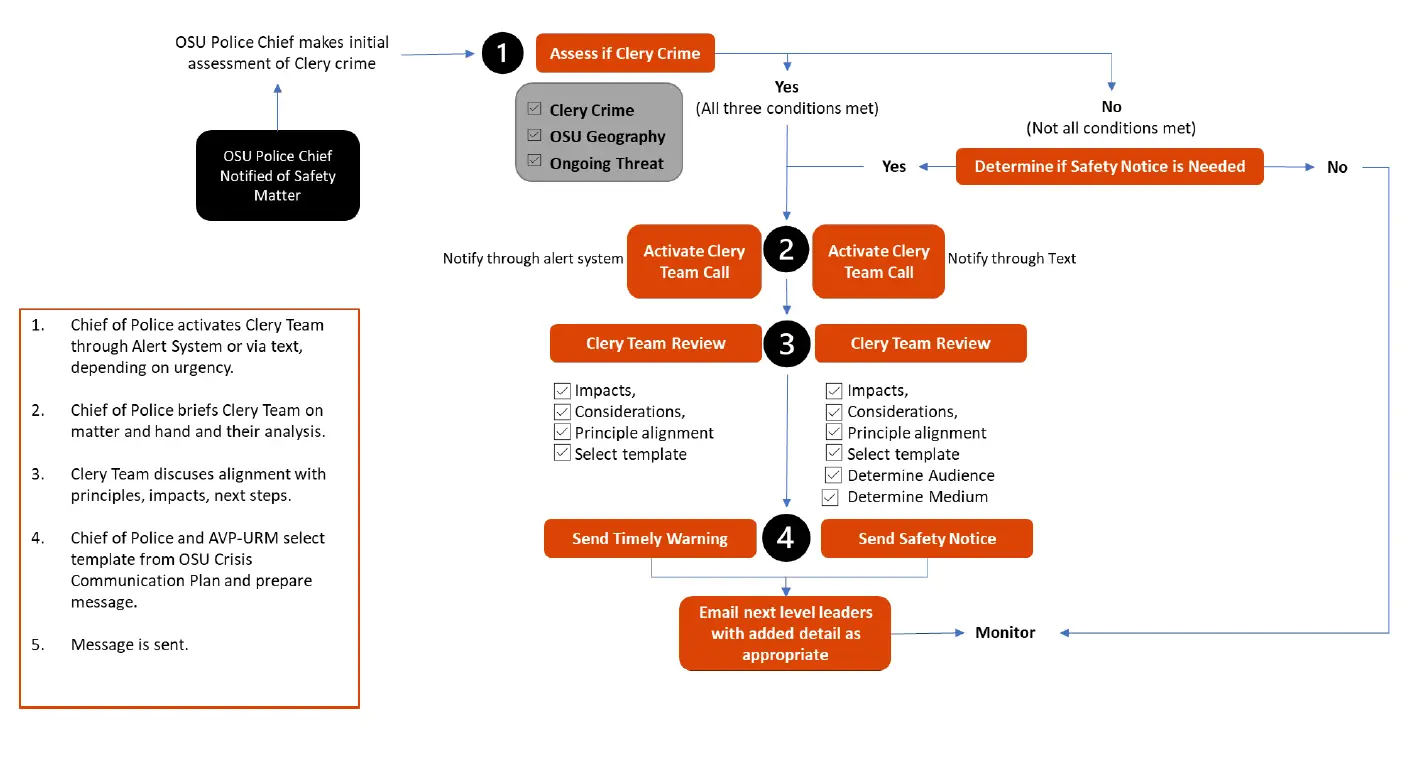
Image Description: Decision-making flowchart for OSU's Clery Act notification process. The chart has two parallel paths — a Timely Warning path on the left and a Safety Notice path on the right — that merge at the end. A numbered summary of steps is provided in a box on the left side of the diagram.
Trigger: The OSU Police Chief is notified of a safety matter and makes an initial assessment of whether it constitutes a Clery crime.
Step 1 — Assess if Clery Crime: Three conditions are evaluated: Is it a Clery Crime? Does it involve OSU Geography? Is there an Ongoing Threat?
- If all three conditions are met (Yes): Proceed down the left path — Timely Warning.
- If not all conditions are met (No): Proceed to "Determine if Safety Notice is Needed."
- If a Safety Notice is needed (Yes): Proceed down the right path — Safety Notice.
- If no Safety Notice is needed (No): Process ends.
Step 2 — Activate Clery Team Call:
- Timely Warning path: Notify through the alert system.
- Safety Notice path: Notify through text.
Step 3 — Clery Team Review: Both paths conduct a team review. The Timely Warning review covers: Impacts, Considerations, Principle alignment, and Select template. The Safety Notice review covers those same items plus: Determine Audience and Determine Medium.
Step 4 — Send Communication:
- Timely Warning path: Send Timely Warning.
- Safety Notice path: Send Safety Notice.
Both paths then merge: Email next level leaders with added detail as appropriate → Monitor (ongoing loop back to monitoring).
Summary of steps (as listed in the diagram):
- Chief of Police activates Clery Team through Alert System or via text, depending on urgency.
- Chief of Police briefs Clery Team on matter and hands off their analysis.
- Clery Team discusses alignment with principles, impacts, and next steps.
- Chief of Police and AVP-URM select template from OSU Crisis Communication Plan and prepare message.
- Message is sent.